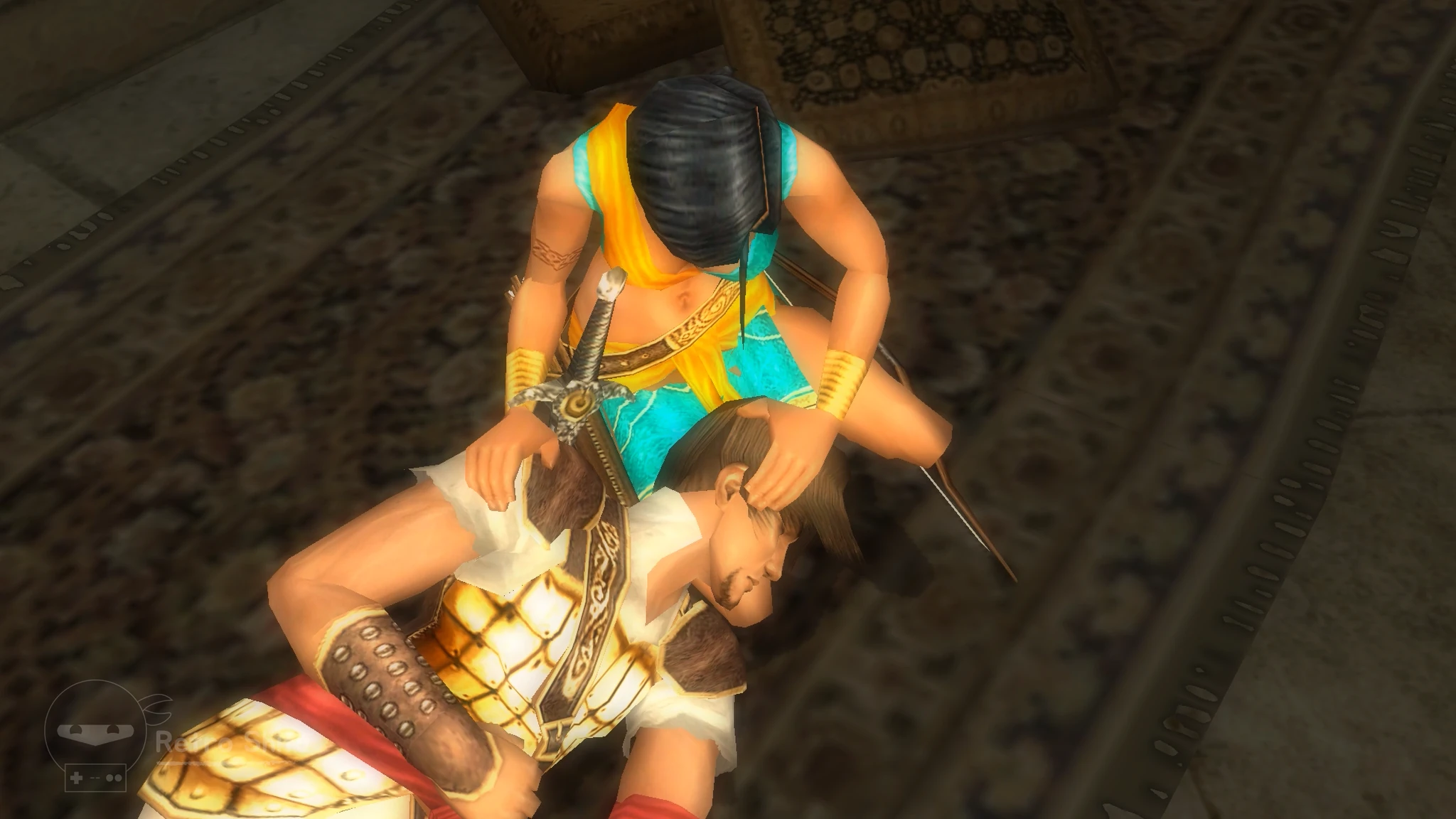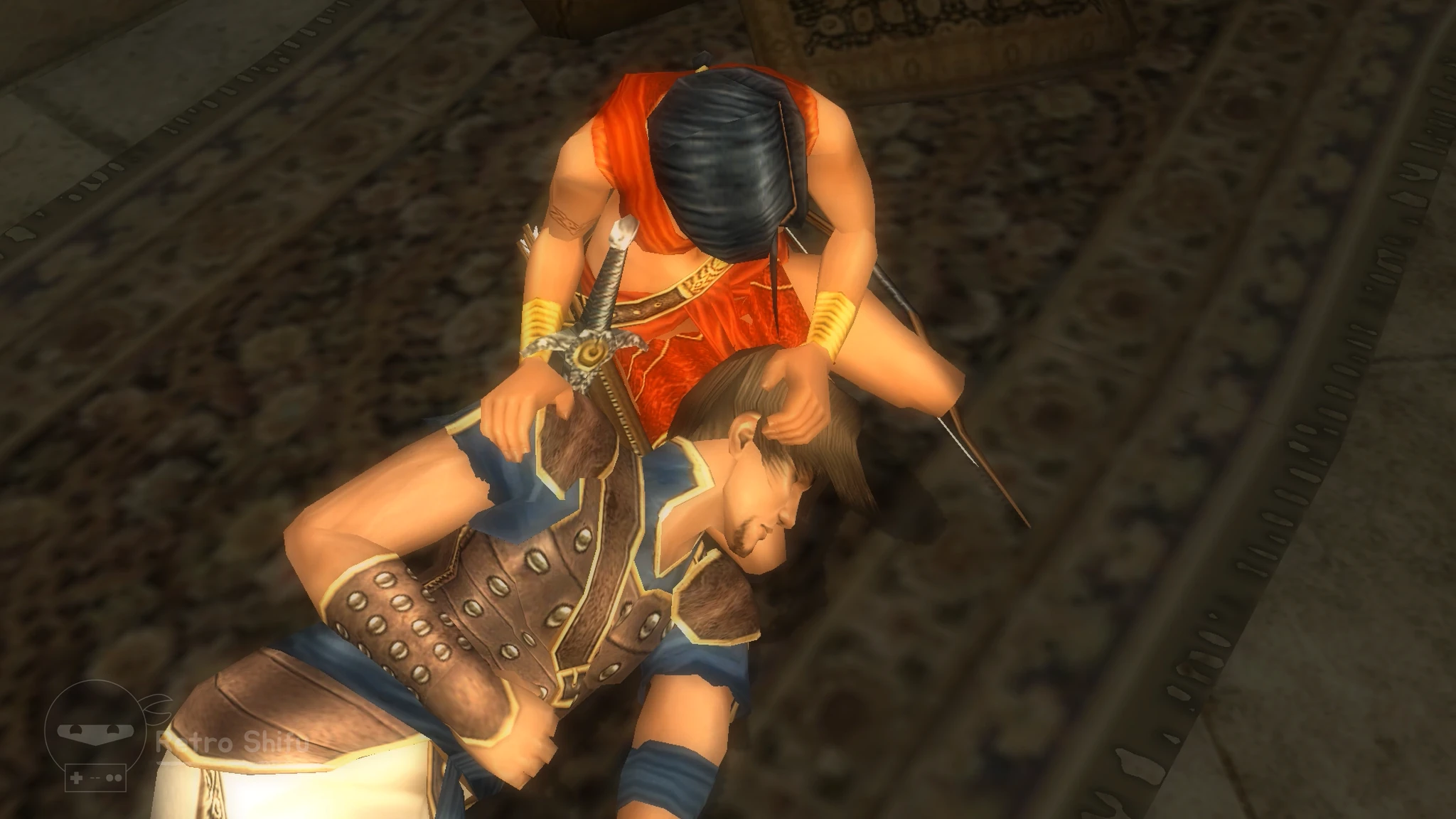
Prince of Persia: The Sands of Time (2003)GOG Video Game Review
Published by Retro Shifu on Wednesday, April 8th, 2026
Video Game Details
Developer
- Ubisoft Montreal
Publisher
- Ubisoft
Release Dates
- North America: Tuesday, December 2nd, 2003
- Europe: Friday, December 3rd, 2003
Introduction
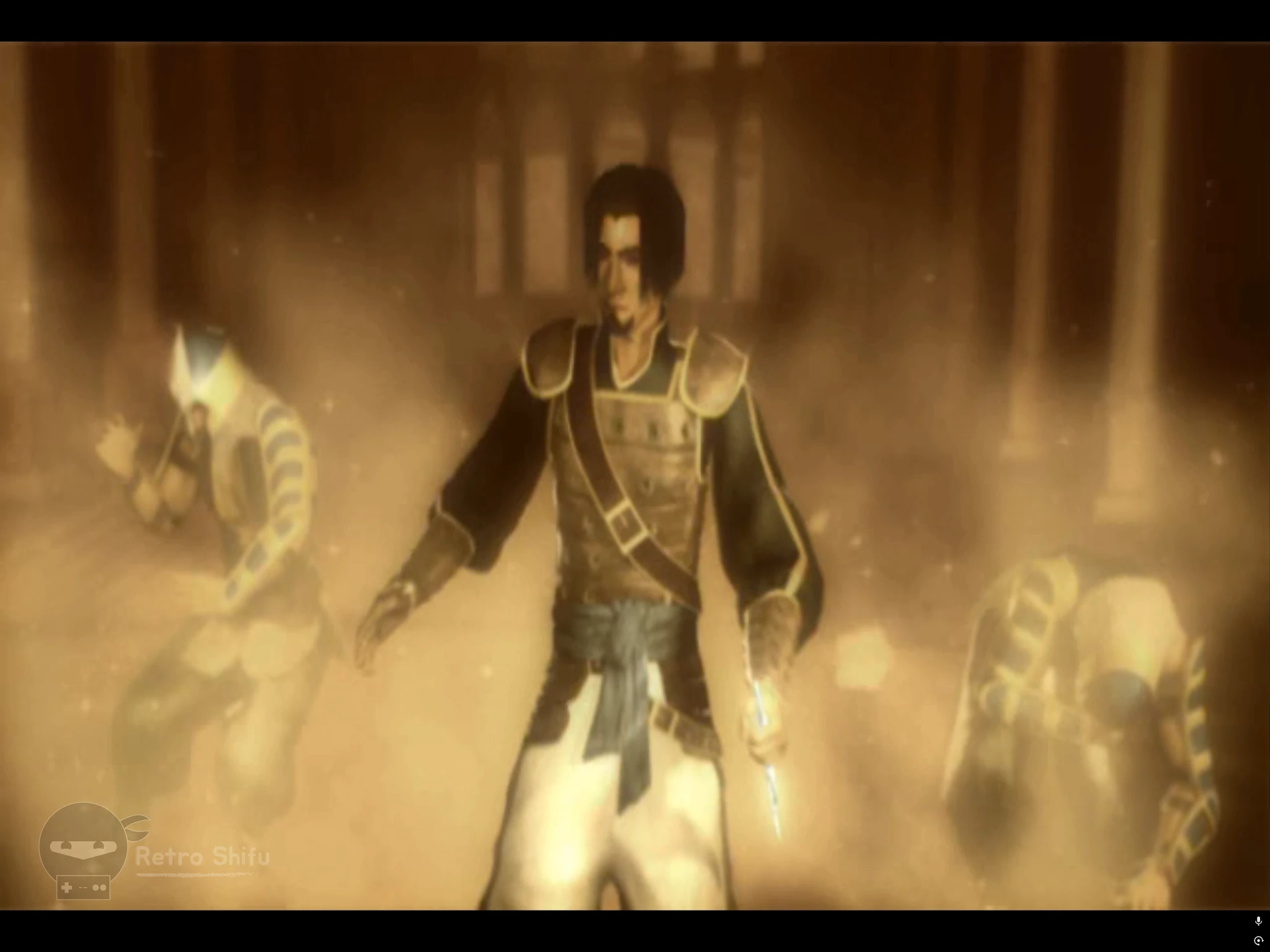
Image credit: Ubisoft Montreal / Ubisoft. Caption: The Prince slowly realizes the immense gravity of his mistake. The Sands of Time, once unleashed, consume and corrupt all that they come into contact with. This pivotal choice must be undone. Will you help?
The Prince of Persia series always interested me as a kid. Back then, I was already a fan of series like Tomb Raider, God of War, and Uncharted. These were action-adventure titles that propelled my imagination to new worlds, and they each had a strong lead character. So to me, Prince of Persia always seemed like the next logical choice, but as a kid, I couldn’t get everything that I wanted. That’s okay. Now that I’m older, I finally had the chance to play a game from the series, and I decided to start with Prince of Persia: The Sands of Time (2003). This game, as I’ve found out, tells a tender love story, makes swashbuckling swordplay spectacular again, and gives you control over beautiful movement in a 3D environment.
Story
The story begins with narration from the Prince, who is of course the main character. He recounts how he and his father, the mighty King Sharhaman, along with a small company of men, set out to meet with the Sultan of Azad, a powerful Persian ruler. On the way to the Sultan, they find themselves in India. Tempted by honor and glory (and a whole lot of treasure and booty), King Shahraman is drawn into a conspiracy to overtake the palace and treasure vault of the Maharaja, a local Indian ruler. With the help of a traitorous Vizier, the Persians conquer the palace with relative ease. The Prince discovers ancient artifacts of immense value: The Dagger of Time and the Hourglass, which contains the fabled Sands of Time. Sharhaman decides to let his son keep the Dagger as a souvenir of his first real battle, and he decides that the Hourglass will serve best as a gift to the Sultan of Azad. The Vizier is visibly troubled by this decision, but he goes along with it until their arrival at the Sultan’s palace. The Persians take more than just ancient artifacts for the Sultan. They also take the rest of the treasure, some exotic animals, and even slave girls. The Maharaja’s own daughter is included.
Playing through the siege of the Maharaja’s palace is difficult. All of the bloodshed and destruction is so senseless and the result of simple, despicable greed. The Prince is honest about his dark nature during these moments.
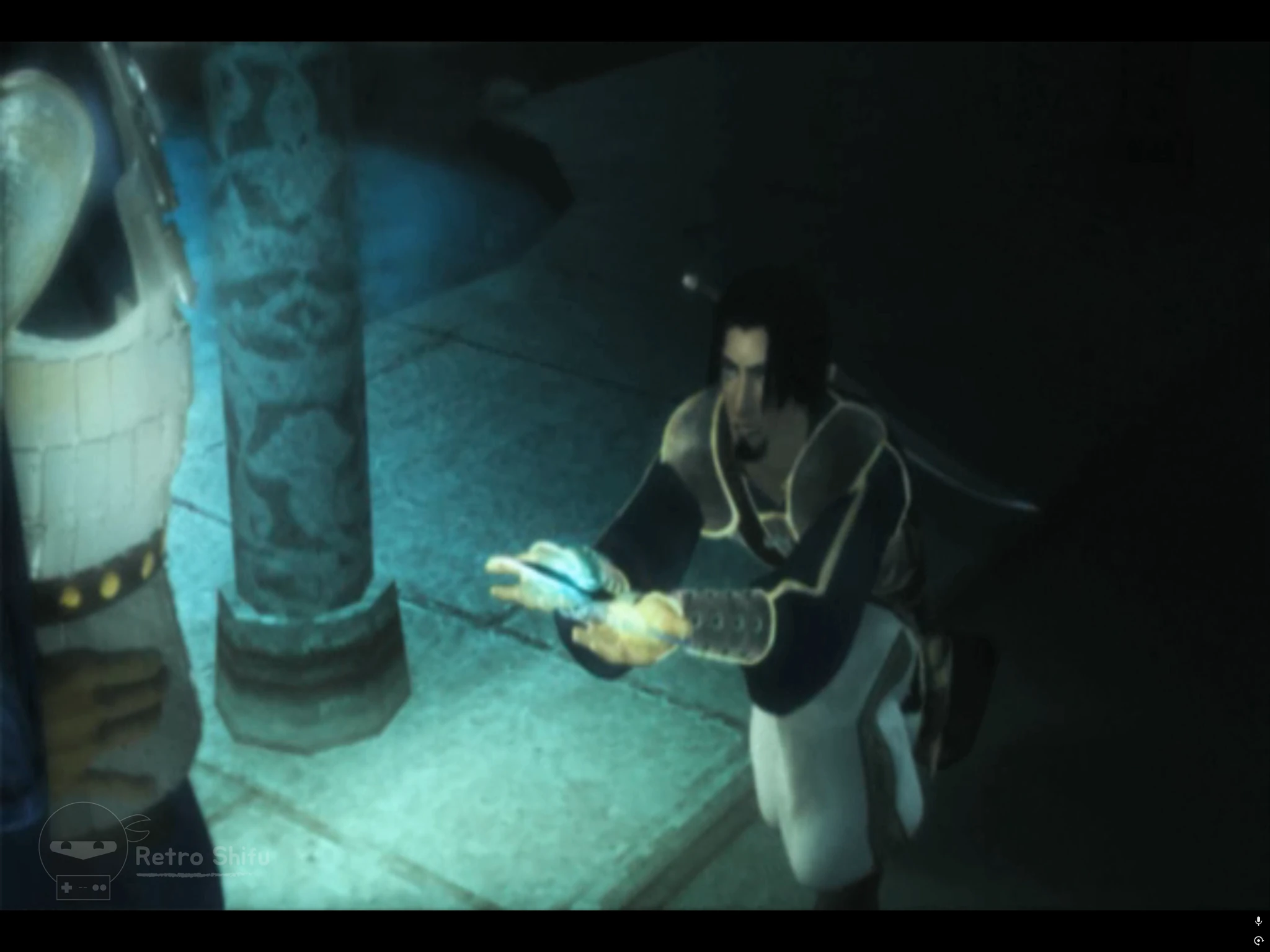
Image credit: Ubisoft Montreal / Ubisoft. Caption: The Prince offers the Dagger of Time to his father. As he lay siege to the Maharaja's palace, all the Prince cared about was pleasing his father. This selfishness and immoral disregard for others would not go without consequence for the Prince.
After the carnage at the Maharaja’s palace and the long journey to Azad, the Prince, his father, and the company of men finally arrive. They meet with the Sultan and present their gifts to him. He is grateful but becomes inevitably entranced by the glowing Sands of Time that are contained within the Hourglass. The Vizier, seeing his opportunity, appeals to the pride of the Prince and implores him to use his Dagger on the Hourglass so as to reveal the true and secret marvel of the Sands to all who are present. The Sultan of Azad looks on in anticipation, and the Prince obliges the overwhelming curiosity of everyone in the room. He inserts the Dagger into the Hourglass, like a key inserted into a lock, and this leads to the unleashing of the Sands of Time. They scatter throughout the room, enveloping the King and the other warriors. The people are transformed into monstrous Sand Creatures, and the palace is rocked violently into ruin. The only survivors of the catastrophe are the Prince, Vizier, and Maharaja’s daughter, who, at the last moment, cries out “Stop!” as the Prince uses the Dagger.
Each of the three survivors is protected from the Sands by an ancient artifact that is as old as the Hourglass itself. The Prince is protected by the Dagger. The Vizier is protected by his staff. And the Maharaja’s daughter is protected by her medallion. The Prince realizes this after fighting through the first onslaught of Sand Creatures that are unleashed. He meets the Maharaja’s daughter, and he notices her medallion and makes the connection: That is how she is protected from the Sands.
The Prince learns that she is called Farah, and the two become inseparably linked for the rest of the story as they quest to contain the Sands of Time and hopefully undo the horror that has been let loose on everyone. Despite their shared goal, the Prince distrusts Farah. He recognizes that she has little reason to cooperate with him because he and his father, King Sharhaman, have just laid waste to the Maharaja, her own father. They have just enslaved her so that she could be gifted to the Sultan of Azad, and they have just stolen precious, dangerous artifacts like the Dagger and the Hourglass. He is worried about working alongside her—always feeling anxiety because of the possibility of her turning against him—but Farah’s beauty, sensitivity, and confidence as a warrior move his heart over time.
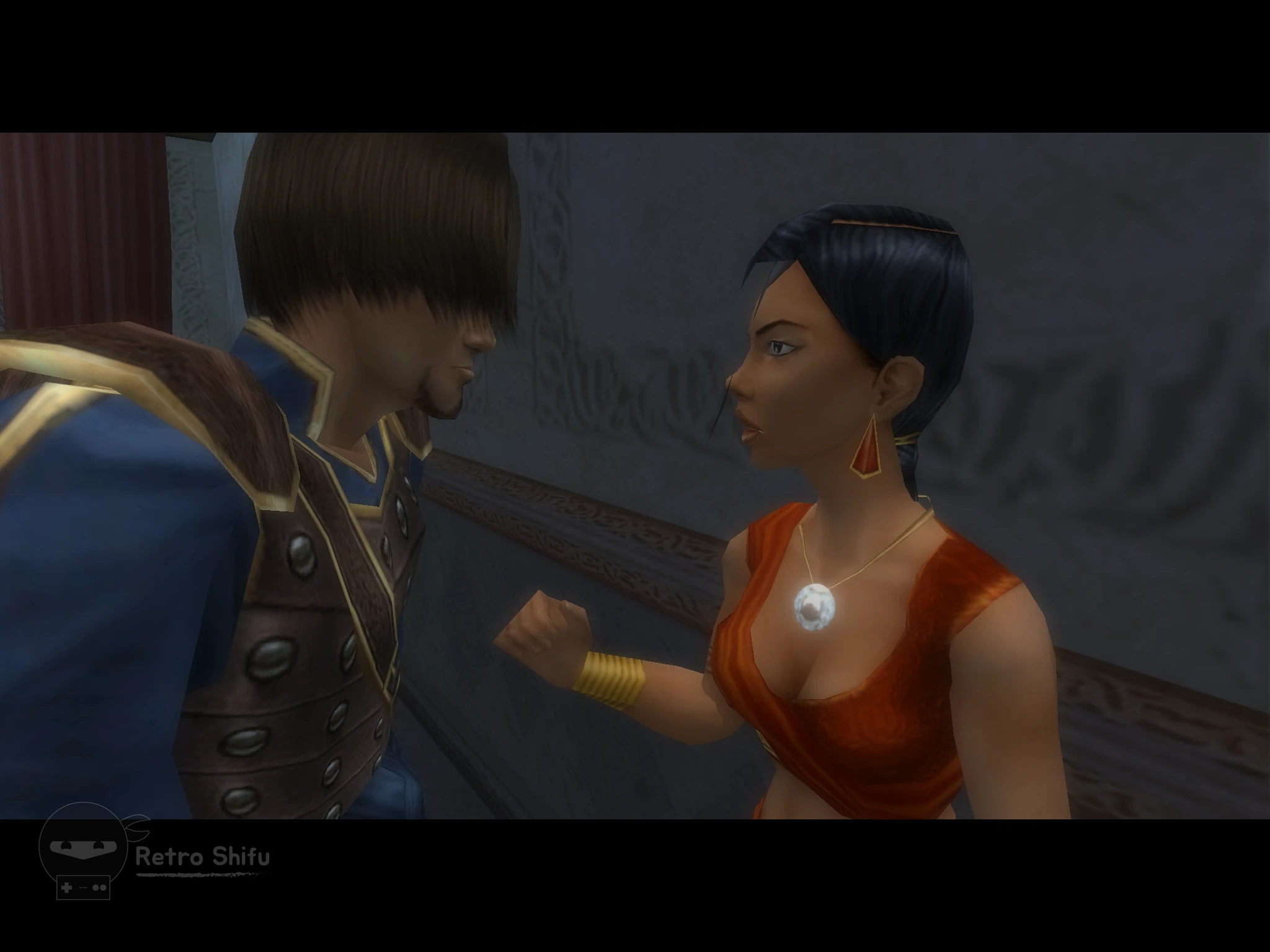
Image credit: Ubisoft Montreal / Ubisoft. Caption: The Prince meets Farah shortly after the Sands of Time are first released from the Hourglass. They argue but eventually learn to work together and more. Farah's medallion protects her from the Sands, and the Prince notices this during their first interaction. Without the medallion, her life would be at risk.
The Prince feels alone. He has just made the biggest mistake of his life. He let himself be tricked by the Vizier into unleashing the Sands of Time. And because of this action, his father is dead. The company of men is gone. Any chance at cooperation or redemption seems so distant. In a key exchange, Farah gives the Prince his much needed chance. She pleads with him to work with her despite their differences, and she appeals to his better nature.
“I have heard it said that you are kind as well as brave. Please believe me. Help me find the Hourglass.”
“It is in the Sultan’s treasure vault atop the Tower of Dawn.”
“How do you know that?”
“I just know. Come with me, then, if you insist. But I warn you I move pretty fast. You better keep up.”
And on they go up and up until reaching the treasure vault atop the tower. Along the way, the Prince has mysterious Sand Visions of the future, or possible futures. These visions help him on his quest. Besides the violent Sand Creatures, there are dangerous traps placed throughout the Sultan’s palace. These hazards stand in the way of the Prince and Farah as they try to right the wrongs of the past. The palace puts all of their skills to the test: combat, navigational, and thinking. There are environmental puzzles throughout that the Prince and Farah must solve together too.
Even though the Prince has agreed to work with Farah, there is always a lingering distrust that he feels between him and her. This distrust builds tension within the Prince as he develops romantic feelings for Farah. As you engage with the story, it is fun to think about what will happen. Will they both fall in love? Will the two of them make it to the treasure vault together? Will they actually find the Hourglass there? Can the Dagger really be used to undo everything wrong that has happened? Will it undo everything right that has happened too? Or will the evil Vizier win out in the end? What is his evil plan exactly? Will the Prince and Farah live happily ever after? Can Farah truly be trusted? Will she betray the Prince? Would that be acceptable if it were to happen? Where do the Hourglass, the Dagger, and the Sands of Time even come from? What other troubles might there be as the two of them make their journey to the top of the tower?
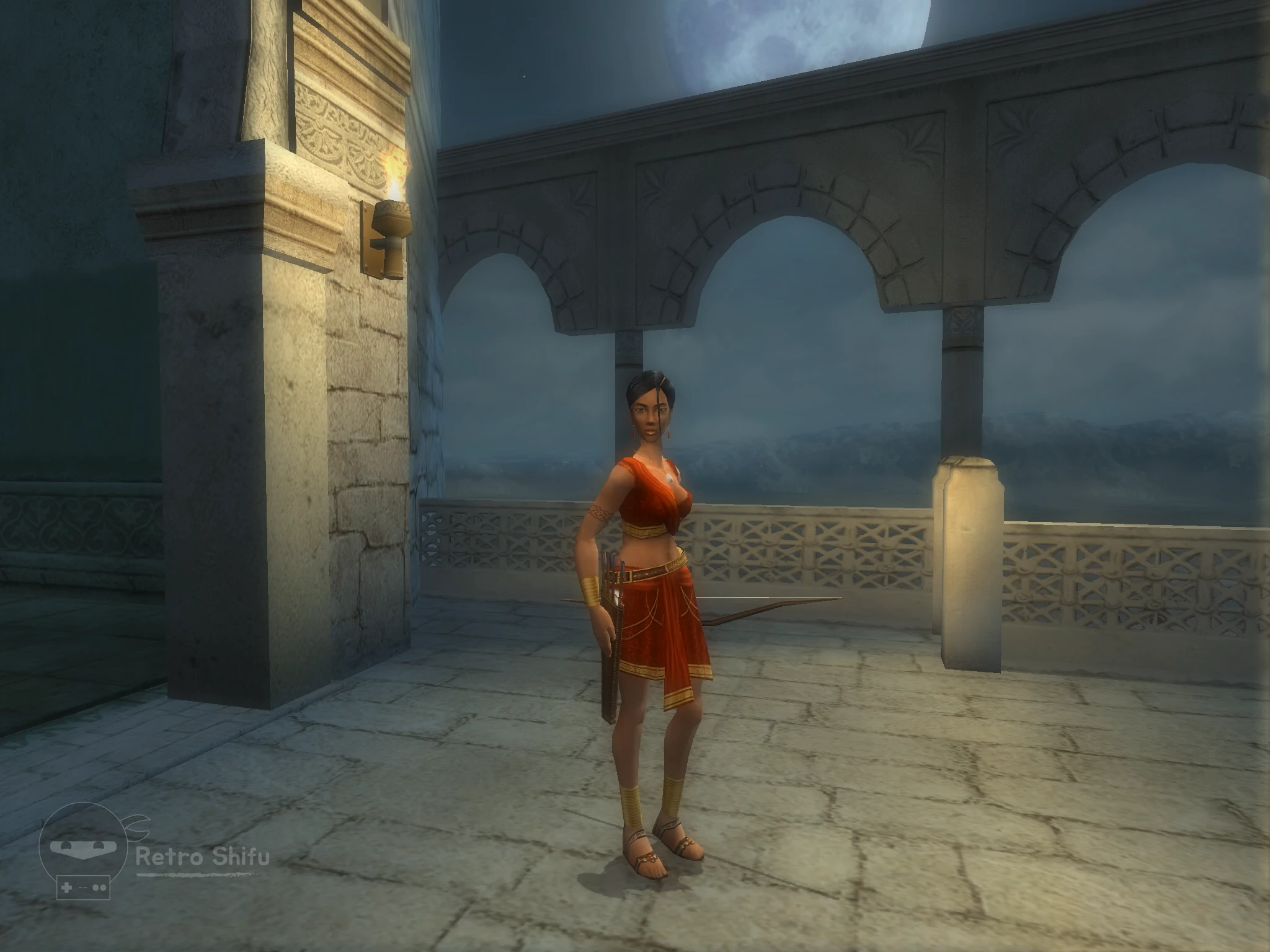
Image credit: Ubisoft Montreal / Ubisoft. Caption: Farah stands at night with the Moon just behind her. Her help is essential to the Prince, who must make his way to the top of the Tower of Dawn in order to undo the calamity that has been created by the Sands of Time.
The story in this game is simple but memorable. The three main characters fill the classic roles of hero, villain, and sidekick, and keeping the number of main characters to only three helps you remember them better. The setting of medieval Persia and its hot desert sands leaves a lasting impression because of its exotic, almost alien-like features. The pre-rendered cutscenes are wonderful because of the detail and fluidity that they present. They feel like they have been cut straight from a feature-length animated film—they’re that good. The narration and dialogue from the Prince (Yuri Lowenthal) is royal, sensitive, and even funny at times. The Vizier (Barry Dennen) is a great foil to the Prince and is treacherous, deceptive, and evil. And Farah (Joanna Wasick) complements the Prince well with her confidence, femininity, and openness. The back and forth between the Prince and Farah, in particular, is weaved into the gameplay in a way that feels natural and spontaneous.
Gameplay
Prince of Persia: The Sands of Time (2003) is a 3D action-adventure game that focuses on combat, platforming, and solving environmental puzzles.
Combat
The exhilaration of battle is here. The Prince’s sword is his primary weapon, and you use it to attack enemies or block their attacks. However, certain enemy attacks are unblockable with the sword. Instead of blocking, you can jump to dodge a sweeping attack from an enemy. This is exciting because it shows off the acrobatic skills of the Prince.
You can move in even more interesting ways during combat. You can roll away quickly to avoid an enemy attack. You can run up a wall and jump off of it to attack an enemy. You can vault over an enemy to get behind it. Sometimes an enemy cannot be vaulted over. When this happens, you can keep slashing at the enemy with your sword until you wear it down for a finishing blow. All of these stylish movements make the combat fun to watch, but the powers of the Dagger of Time might be even more fun.
The Dagger plays an important role when fighting. You can use its Power of Restraint to freeze an enemy. This leaves the enemy vulnerable to a finishing slice from your sword. You can use its Power of Delay to enter slow motion. This helps you notice and dodge the unblockable sweeping attacks from enemies. You can use its Power of Haste to freeze all the enemies around you. Then you can fast forward to their locations in order to strike them down once and for all. The Dagger’s powers are a dominant and fantastical element of the combat that you learn to value and savor.
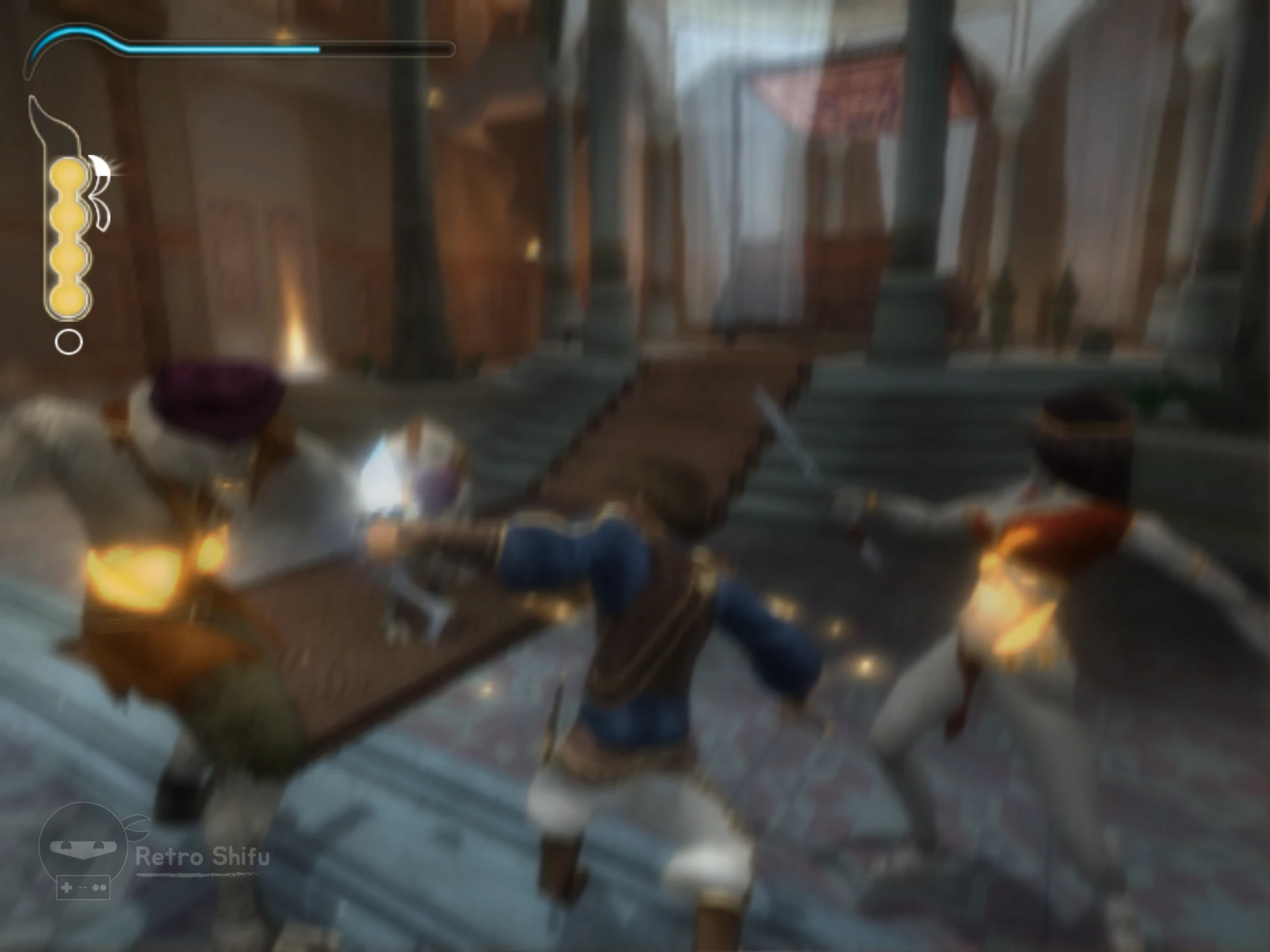
Image credit: Ubisoft Montreal / Ubisoft. Caption: The Prince's Daggger has many amazing powers. Its Power of Delay can be used to slow down time, for example. This makes spotting an incoming enemy attack much easier, and it also comes with a cool visual effect that blurs your screen.
There is no such thing as a free lunch, and this old saying holds true for the Dagger’s capabilities as well. To use them, you need to retrieve the ancient Sands of Time by plunging the Dagger into the Sands. This is the price to be paid for such awesome powers. You can obtain the Sands from the Sand Clouds that are scattered throughout the palace. Sometimes these are placed in locations that are difficult to reach, but because of the reward that they hold, you do whatever it takes to get to them. You can obtain the Sands from fallen enemies too. This is crucial because, if not absorbed into the Dagger, the Sands will reanimate a fallen enemy, effectively making them immortal. As you move from enemy to enemy, you make sure to absorb the Sands from fallen ones whenever there is an opening to do so. This is fun because you always feel like you are on a timer to retrieve the Sands from a fallen enemy before it comes back to life. You are also always worried that you might get attacked by yet another enemy while you are trying to do so.
Forunately, Farah fights alongside you. She uses a bow and arrow and is a decent shot, most of the time anyway. She is capable of stunning enemies so that they are ready to receive one final attack from you. This is really helpful, and it makes the combat feel like a team effort. But if she takes too much damage, it’s game over. Rushing over to help her becomes a priority as you block, dodge, and attack your way through a horde of enemies.
The variety of enemies is good. Early on, you encounter fierce Indian warriors who are in the service of the Maharaja. Then, once the Sands of Time have been unleashed upon the Sultan of Azad’s palace, you face off against a variety of Sand Creatures. These monsters are horrifying, and the immortality granted to them by the Sands makes them relentless opponents. One cool feature is the color coding of the Sand Creatures: Red warriors can be vaulted over but blue warriors cannot be. This keeps the combat lively because you are constantly making decisions about who you vault over. If you choose wrong, you could take damage or die. Ultimately, It is sad to see what were once noble warriors or beautiful women transformed into these things. It turns combat into a matter of not only survival but of cleansing the world of corruption.
The killer birds and scarabs that you encounter leave the world feeling even more desolate and as if it were only filled with scavengers and insects meaning to harm you. When it comes to the birds, you often have to wait and block before you can attack them, or you have to time a sword slash just right before the birds dive down to get you. Seeing the different enemies, and figuring out how to fight them, is stimulating and keeps the combat from getting stale. With this in mind, a minor gripe I have is that I would have liked to have seen even more kinds of Sand Creatures. At the beginning of the game, the Prince’s father, King Sharhaman, makes it clear that exotic animals are taken from the Maharaja’s palace to the Sultan of Azad, but you never actually see these in the game. This is unfortunate because it would have been wicked cool to see a Sand Creature based on animals like the lion, elephant, or maybe even a rhinoceros or something. But in any case, the terror that is created by the enemies that are present makes the Prince’s abilities as a warrior and his possession of the Dagger all the more important.
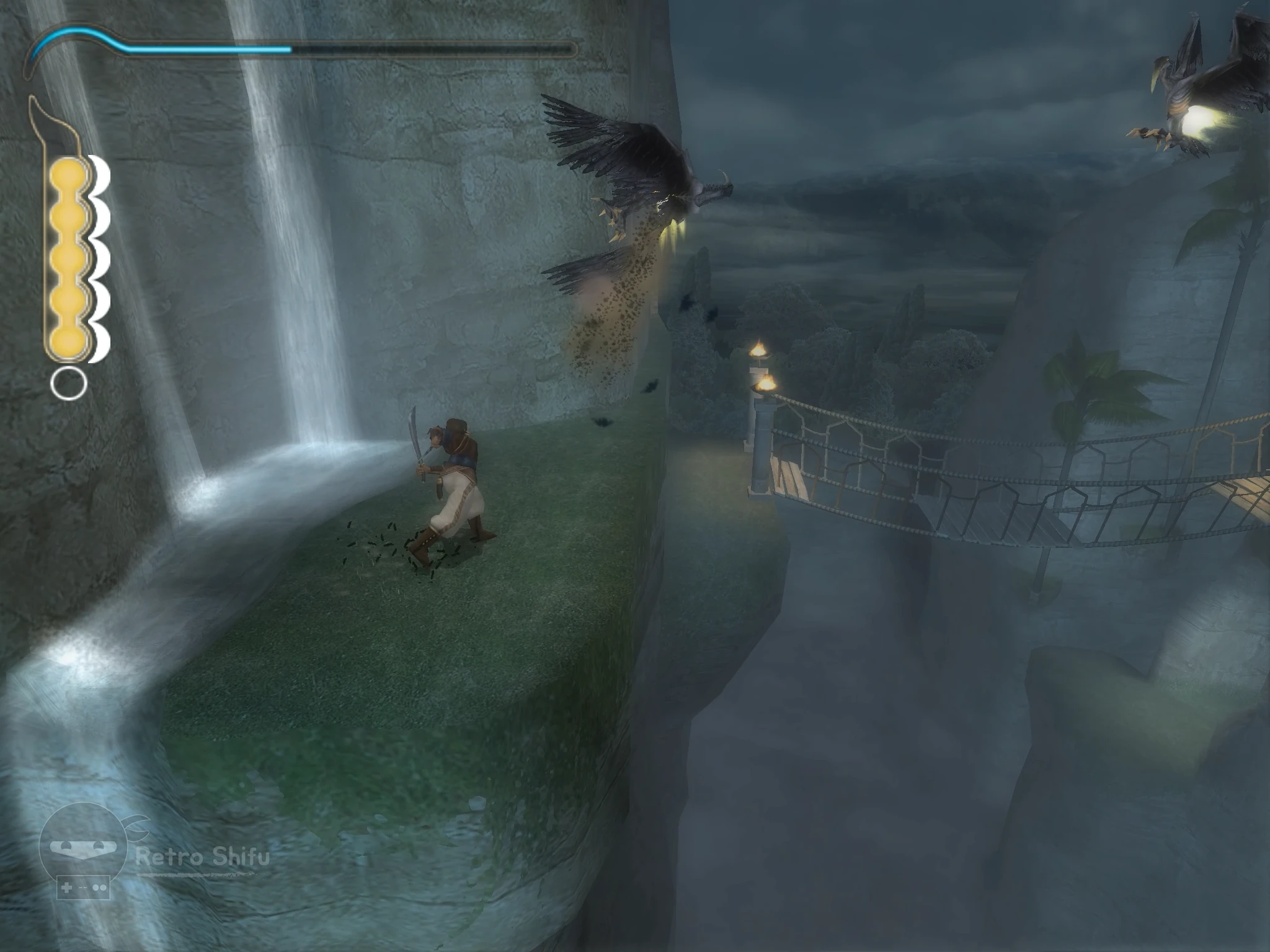
Image credit: Ubisoft Montreal / Ubisoft. Caption: You fight many different enemies as the Prince. The Sands of Time have corrupted people as well as animals and insects. Here the Prince fights off a pack of swarming Sand Vultures. He has to block their piercing beaks or slash them with his sword with perfect timing.
The Sands are required for the Dagger’s powers to be used. When you get some, you fill your Sand Tanks and Power Tanks. The filling of these tanks is what enables the different powers of the Dagger. As you progress through the game, you grow additional tanks. The Power Tanks allow you to use the combat-based Dagger abilities: The Power of Restraint (Freeze), the Power of Delay (Slow Motion), and the Power of Haste (Fast-Forward). The Sand Tanks allow you to use the story-based Power of Destiny to see visions of the future. They also allow you to use the platforming-based Power of Revival to rewind time in order to undo a mistake. The latter comes in handy for the many platforming segments in the game.
Platforming
The combat is not the only strong suit of this game. The platforming that you can carry out is arguably just as exciting, if not more so. The Prince is agile not only when fighting but also when traveling through the palace and overcoming the traps that are everywhere. You move at a brisk pace and can climb up objects with ease. You can even scale a wall by running up it so that you can reach a ledge to pull yourself up. The Prince’s ability to run along a wall in order to overcome a gap in the path is by far one of the coolest and most satisfying ways to move the character. Sometimes this wall running ability can be used to easily overcome a trap, and other times it is clear from the way that a trap is set up that the wall running ability has been intentionally blocked by the game designers to challenge you. These different movements are impressive and are just the tip of the platforming iceberg.
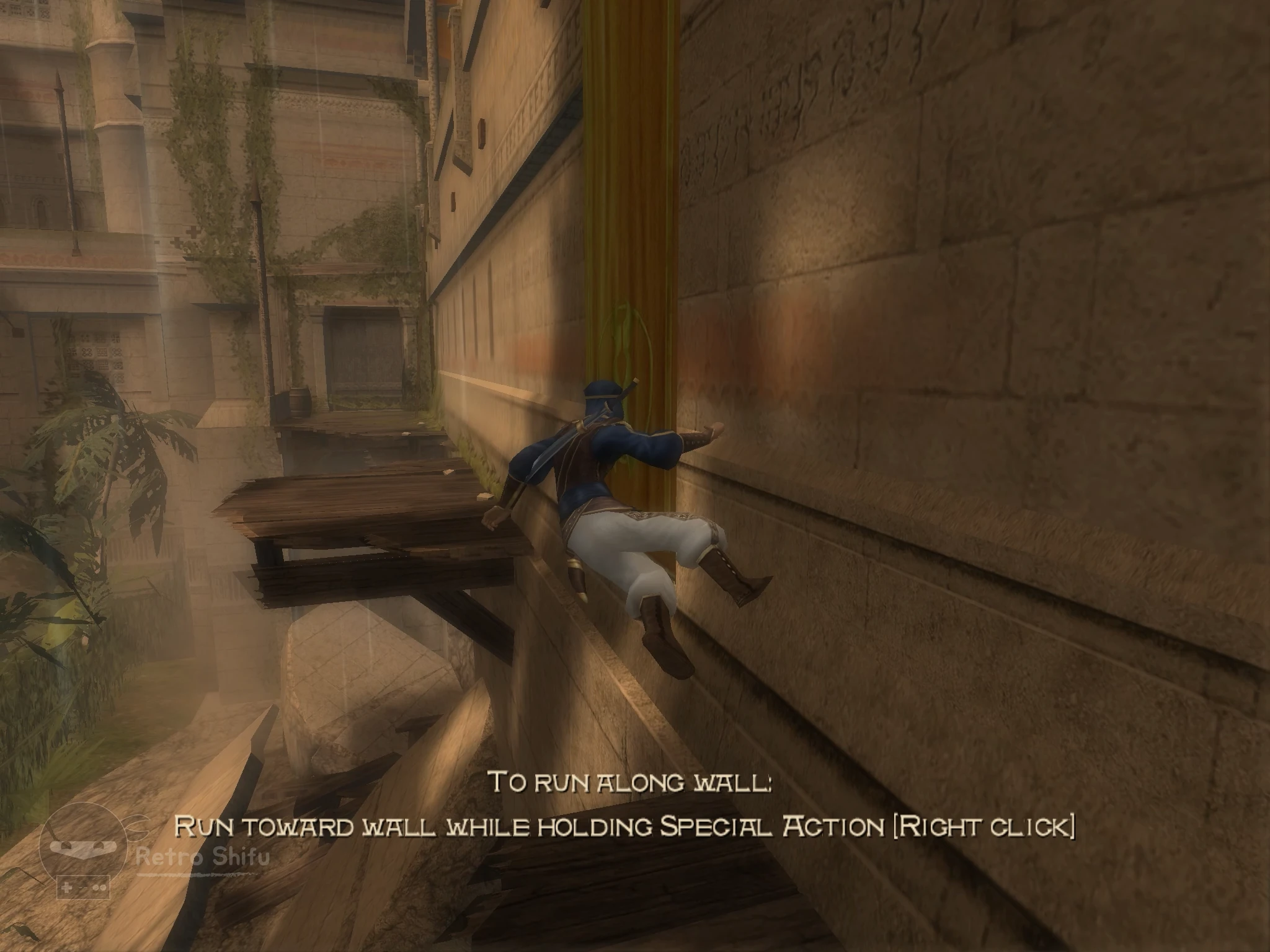
Image credit: Ubisoft Montreal / Ubisoft. Caption: Wall running is one of the coolest features in the game. You can run along any wall, and this is especially helpful when there is a break in the path that would otherwise be impassable. You can even wall run and then jump off to continue platforming a different directions. It's effortless and looks great.
The Prince has other platforming-based moves, like the ability to hold on to a ledge from below or climb up it. Once on a ledge, he clings to the wall as he moves to keep himself safe. This mechanic makes for interesting gameplay segments where you find yourself hurriedly trying to figure out the correct path to take while the ledges that you are on keep crumbling.
The Prince can grab onto columns too. You can move in different directions while holding onto a column to make sure that your next jump is just right. If you mess up and fall to your death, you can use the Dagger’s Power of Revival (Rewind) to reverse time by up to 10 seconds. This is integrative because it is a way for the Dagger to become part of not only the narrative and the combat but also the platforming. I found myself using this Dagger power whenever it was difficult for me to judge the distance to a platform or the right direction that I was supposed to go in.
The game is principally played from the third-person perspective, but a couple of other ones are also available. You can see things from a first-person perspective. This is nice because it lets you admire the views afforded by the Sultan’s palace and, more important for gameplay, it lets you better gauge the different directions that you can go in while platforming. You can also see things from a bird’s-eye view. This is useful because it gives you a greater sense of the environment, and it can help when you are figuring out certain puzzles.
Before we talk about puzzles, there’s still so much more to appreciate when it comes to the platforming in this game. You can grab hold of horizontal poles so that you can swing to the next platform. You have to time your jump just right as you are swinging. You can swing from one of these poles so that you can kick yourself off a wall and then onto yet another pole. This is challenging to do because you have to time the kick off the wall just right, or you will fall to your death. You can also grab hold of ropes and swing back and forth like a veritable swashbuckling hero. Sometimes it is important to descend the rope first before swinging, and just like when jumping from the poles, you can also jump from the rope, kick off a wall, and then jump back. The poles and ropes are a visually exciting feature of the platforming, but there’s still more.
The Prince can walk along beams. As you do this, you have to maintain your balance and be aware of potential enemies, especially killer flying birds or bats, that can knock you off to your death. Sometimes falling is the point, though, and you need to use the Prince’s skills to fall with style. You can jump between walls that are close together. You can do this to safely go down an otherwise deadly drop, or you can do this to go up an otherwise impossible climb. It’s easy to fall when executing these kinds of gravity defying movements because the timing is everything. One wrong button press, and you’re going down. Permanently. Or at least until you hit rewind.
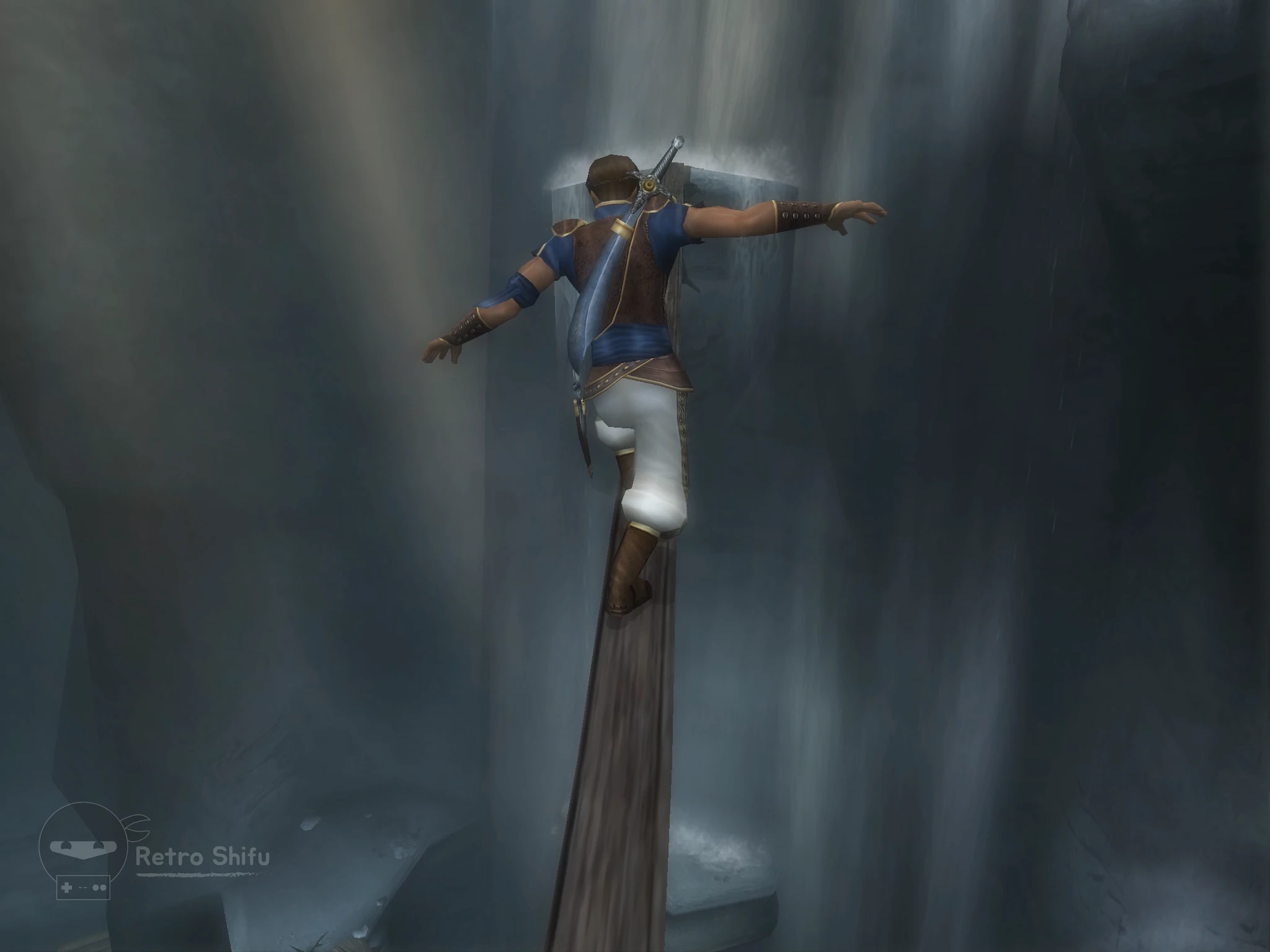
Image credit: Ubisoft Montreal / Ubisoft. Caption: The Prince is a daring adventurer who can traverse his environment with the utmost skill. Walking along beams is just one example of this. As you try not to look down, you must maintain your balance. If you don't succeed, the Sands of Time will forever go on to destroy the rest of the world.
The game ups the ante by mixing the platforming with deadly traps that would make even Indianna Jones’s stomach drop. (Speaking of an upset stomach … I don’t think the Prince ever eats in this game.) There are spiked poles that spin and move back and forth in an attempt to block your way. There are blades that protrude from the walls and move towards you over and over again to try to get you. There are spiked logs that hang from the ceiling and that swing to and fro ready to knock you back or impale you repeatedly. There are spinning blades on the ground that you have to maneuver around or you’ll die. There are pits filled with spikes eager to get you. There are spikes that can pop out of the ground at a moment’s notice if you do not carefully walk over them. These twisted traps test your abilities to the max, and, in retrospect, it sort of makes sense that the Prince would struggle so much to fully trust Farah given how everything in the palace seems out to get him.
Quickly! As if the traps alone weren’t enough, many of the platforming segments that involve them are also on a timer. That’s right. Yellow switches will often open important doors, but only for a limited amount of time. These timed doors are of course sadistically placed at the end of a series of savage traps. As the Prince, you have to make your way to the door just in time before it closes. If it closes before you make it through, you are forced to go all the way back through the traps, reactivate the yellow switch, and then you have to retry everything. It can be frustrating when you fail to make it in time, but when you finally have all of the jumps and timings of the traps just right, it is so satisfying to roll your way through that falling yellow door and make it to the next area. Blue switches are used for more permanent interactions with the environment and are not timer dependent. These can show up during some of the environmental puzzles that you have to solve.
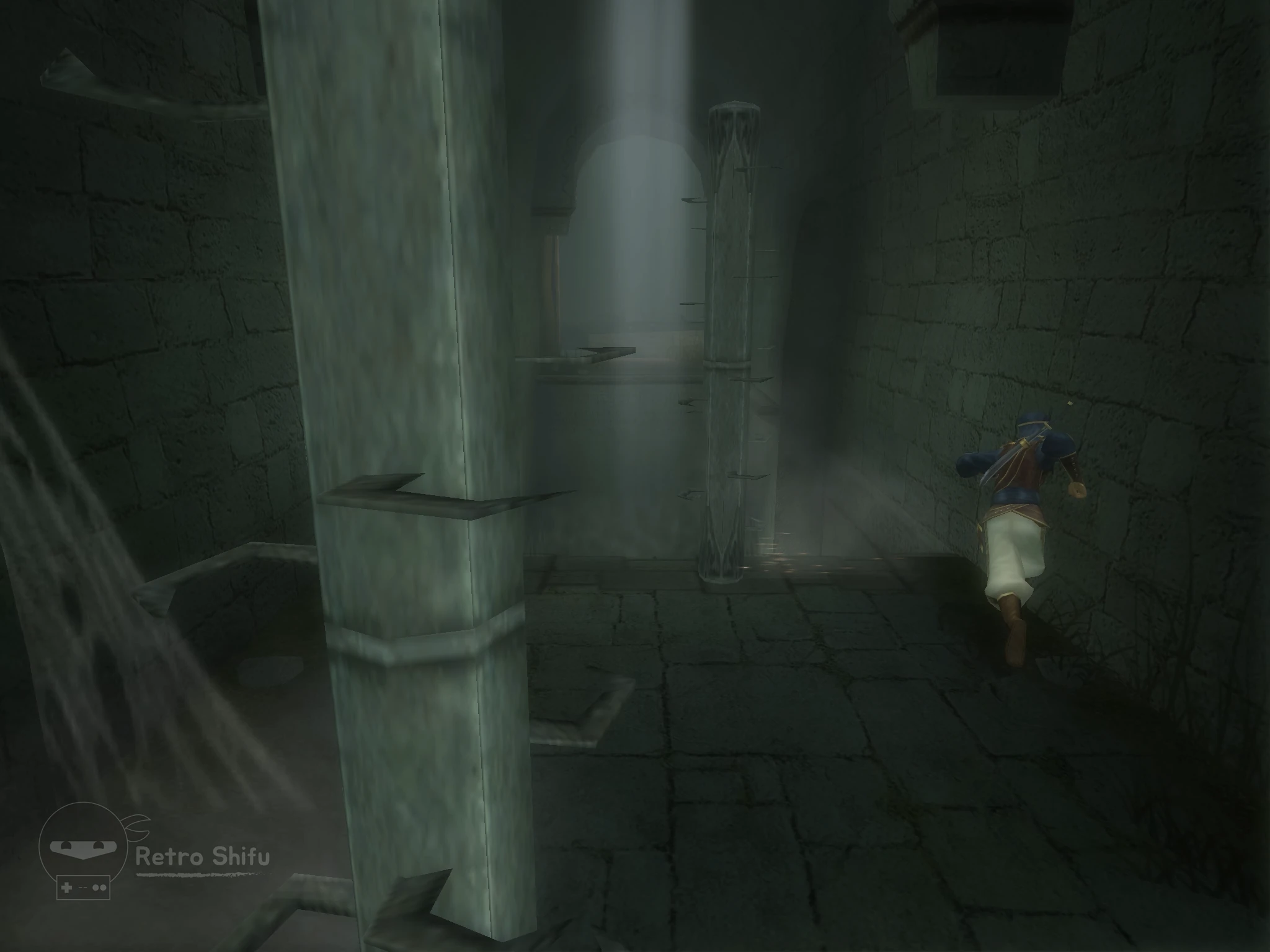
Image credit: Ubisoft Montreal / Ubisoft. Caption: Traps fill the Sultan's palace. Sometimes all you have to do is run past them. Other times it's not that simple, and you find yourself using all of the Prince's platforming abilities to survive.
Environmental Puzzles
The Prince can interact with his environment in different ways in order to overcome the puzzles that are built within it. These puzzles vary in the kinds of interaction that they require. Sometimes you complete them alone, and sometimes you complete them with the help of your trusty companion, Farah.
Working alone, you can grab hold of things like bookcases or stone blocks, and you can move them about to reveal secret passageways or to gain elevation so that you can climb up to a hard to reach place. Sometimes you can manipulate the entire platform that you’re standing on, or you can manipulate different parts of an entire room so that you can move on in the game.
Farah can help you in your attempts to solve the puzzles. She can pull switches that you can’t reach. She can fit through cracks in the walls to reach areas that you could never get to. Her dialogue is helpful too and gives you hints about what is happening or what you might have to do next. Working with Farah on the puzzles is a nice break from the intensity of the combat and the pressure to time all of the platforming just right. It is also a way to develop the bond between the Prince and Farah, which is so integral to the story.
The puzzles that involve light rays are particulary memorable. Redirecting beams of light to open the door to the next area can be challenging, but it is rewarding when you finally figure out the proper positions for the mirrors that you need to move around. Also, given the historical impact of Persian scholars on the science of light and optics, these puzzles feel very much at home here. And, like light traveling along a straight path, the game is very linear and sets you down the same set of trials playthrough after playthrough.
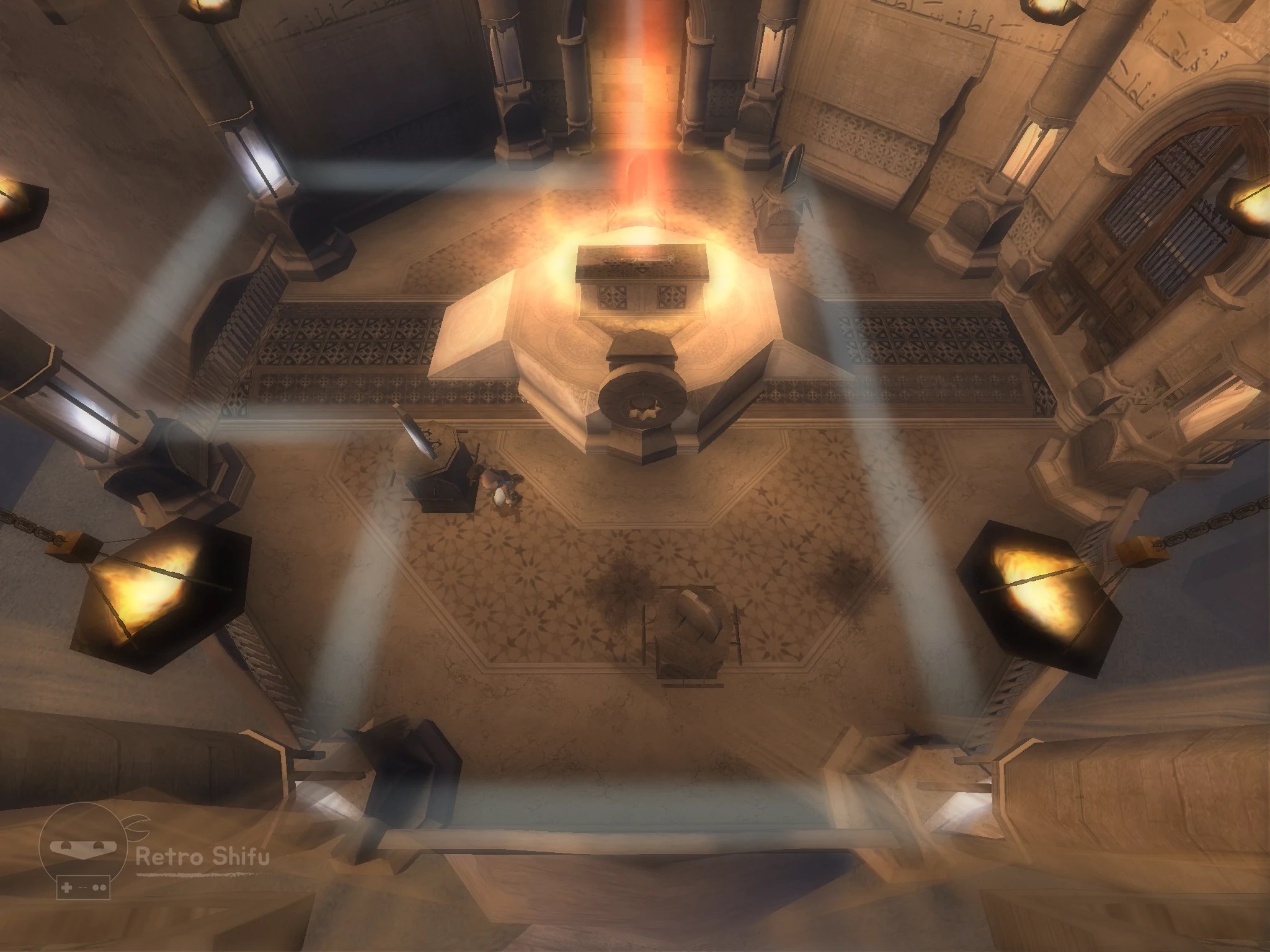
Image credit: Ubisoft Montreal / Ubisoft. Caption: The environmental puzzles may be solved alone or with the help of Farah. Sometimes the puzzles are more mechanical in nature, requiring you to move boxes, activate pressure plates, or interact with switches. And other times the puzzles involve the classic use of light rays and mirros. These puzzles fit right in because of the medieval Persian setting, a time and place forever tied to the study of light and optics. Here a bird's-eye view is used to better solve the puzzle.
The combat, the platforming, the environmental puzzles, all of it can kill you, which is unfortunate for the Prince but exciting for you as the player because of the challenges that you overcome going from start to finish. You are bound to take damage during all of this. Fortunately, you can recover your health by drinking water. (Yes, it’s that easy. Make sure to stay hydrated, folks.) There are water fountains and baths located throughout the Sultan’s palace that are ready for you to drink from. If the amount of health that you begin with isn’t enough for you, then you can go out and get more.
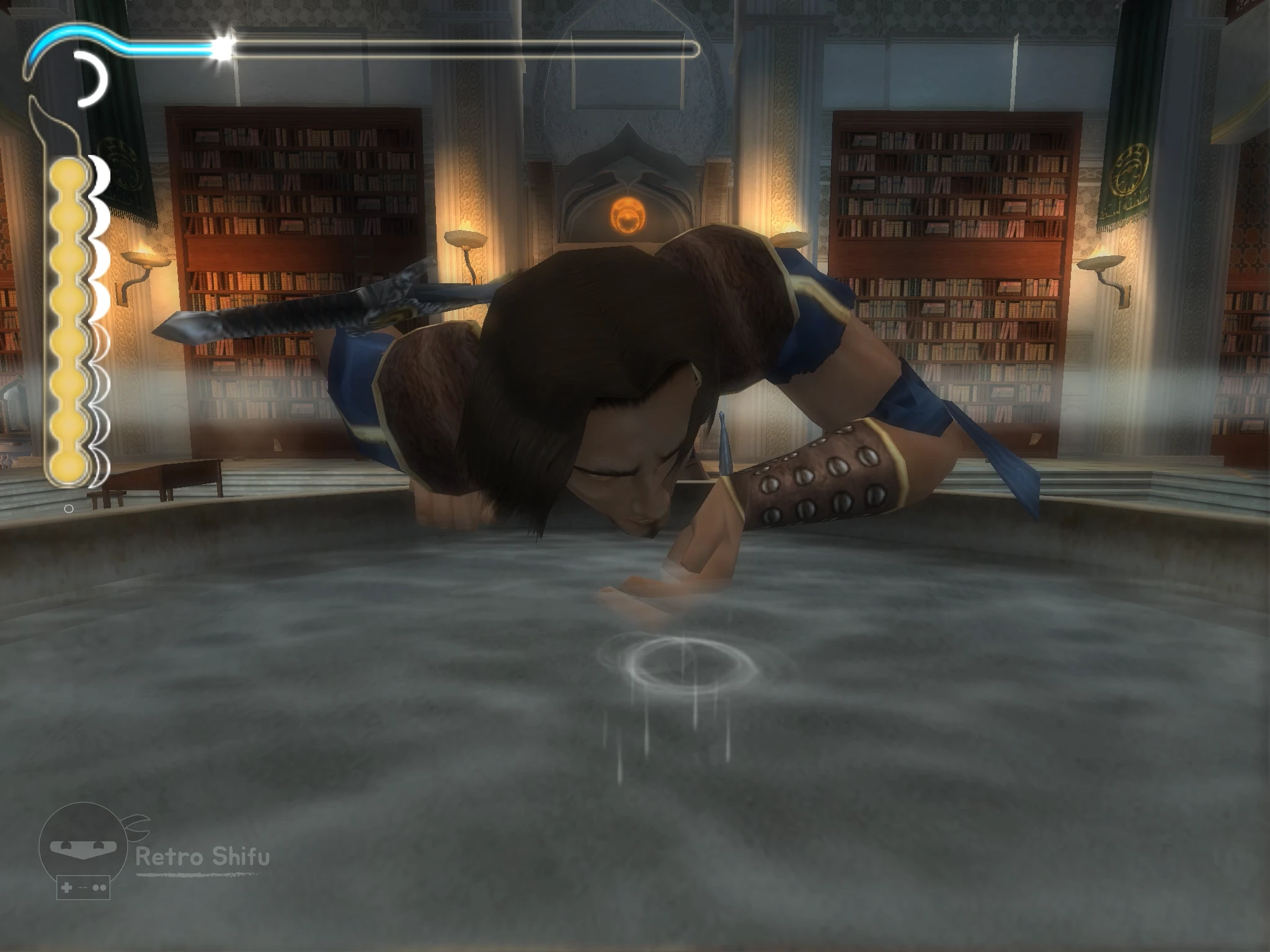
Image credit: Ubisoft Montreal / Ubisoft. Caption: Water is your source of health. Drinking it is vital if you want to continue to withstand the Sand Creatures that are working against you and Farah. Fountains like this one can be found throughout the Sultan's palace, and each one is much appreciated.
For a permanent boost to your health bar, you can visit Magic Fountains. The corridors that lead to these fountains can be easily missed if you are not careful in your explorations. Sometimes, the fountains are even hidden behind breakable walls. Finding them can feel like a puzzle unto itself. These fountains are one of my favorite parts of the game because of the atmosphere that they create. They are beautiful to see and hear, and they almost seem too strange to be real. They leave you questioning what they might actually be and if the health upgrade is the only true effect being had on the Prince. They have this enigmatic pull on you whenever you find them.
Saving your game is just as mesmerizing an experience as increasing your overall health. Throughout the palace, there are Sand Vortexes. These columns of light made up of the glowing Sands of Time allow you to save your progress every time you step into one. At first, you are lifted up to hallucinatory visions of the future, and then you can choose to save your game file. If you wish to re-watch the visions, you can just step right back into the vortex. I chose to do this from time to time if I felt uneasy about what I might have to do moving forward, especially if the platforming ahead of me seemed difficult. The Sand Vortexes, like the Magic Fountains, bolster the magical feeling that permeates the entire game. Each vortex leaves you wondering about what is going on and what might happen next.
Graphics
The game is rendered in full 3D and is stunning to look at even today. It’s a perfect reminder of how far 3D games had come during the sixth generation of video game consoles. From the very beginning of the game at the Maharaja’s palace, the environment is so detailed inside and outside. You can see the impenetrable stone masonry of the palace, and you can appreciate all of its wooden walkways, ladders, flags, and fountains with ease. The pointed rooftops, columns, and castle-like windows of the buildings wonderfully paint the Indian setting. And the lush foliage of the desert vines and palm trees that are placed throughout adds touches of green to your screen. The rooms are lit by torches to keep the shadows at bay, and harsh metal gates meant to keep out intruders are common. The walls are decorated with beautiful, intricate patterns that are indicative of the architecture in India. Impressive statues adorn the environments as well. The dark corridors of the palace are pierced by welcomed shafts of light. You feel the attention to design and presentation that was put into this game just by looking at it.
The Sultan of Azad’s palace continues much of the art direction that is established in India. The extravagance of the palace is on beautiful display in the reception hall with all of its magnificent red and gold carpets, with its large inviting windows, and with its beautiful stoneworked water fountain. The walls of the guest quarters are beautifully embellished with patterns as well, and all of the furnishings are exquisite, from the beds to the curtains. Everywhere, the water in the fountains flows nicely, adding cool hues of blue. While there is much prettiness to admire, the Sands of Time have left so much of the Sultan’s place destroyed. One can’t help but be reminded of the destruction that the Maharaja’s palace was met with.
As you fight, maneuver, and outsmart your way to the top of the Tower of Dawn in search of the Hourglass, you can’t help but marvel at the broken floors, crumbling ledges, blown out walls, and toppled columns that are everywhere. The game’s visuals clearly convey just how shattered the palace has become. The story and gameplay never feel held back by the graphics, only enhanced.
The Prince, Vizier, and Farah all come alive on screen. They are beautifully modeled in both the pre-rendered cutscenes and actual gameplay. Their costume designs are spot on, and they fit the tone of the story and the time and place of the setting. Although cartoonish in style, the Prince gives off the look of a dignified, strong, and gallant protagonist. His dark blue shirt, brown leather armor, and bright white pants are what help to achieve this effect. The Vizier, however, looks arrogant and violent with his long robe covered in dark purple and red. But Farah’s red and gold dress is provocative and contrasts nicely with the relative modesty of the Prince’s outfit. All of the characters, including the enemies, look like someone really cared deeply for the final product, and the same can be said of the character animations.
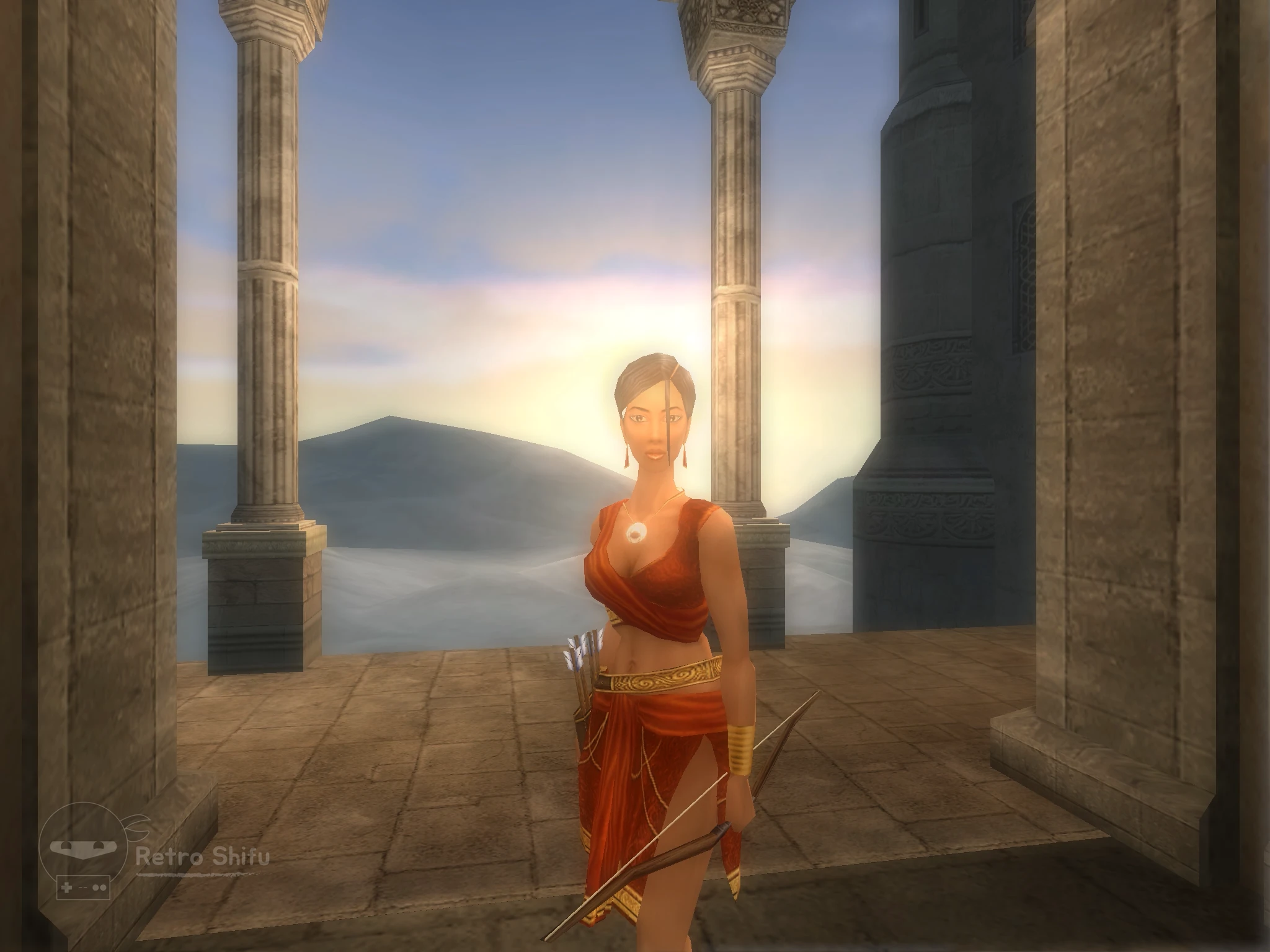
Image credit: Ubisoft Montreal / Ubisoft. Caption: The game provides many beautiful views. The environment transitions between day and night, light and dark. The characters fill the screen against these pretty backdrops in such an enticing way. Here, Farah stands ready to help the Prince and continue their journey with the radiant Sun just behind here.
The Prince, like so much of the in-game world, moves naturally. All of his attacks and feats of acrobatic skill flow smoothly between each other. Farah is equally accounted for, and so too are the enemies, traps, and effects that are used throughout the game. The transitions between day and night that occur as you progress happen seamlessly, and the subtle changes to the Prince’s outfit show his struggle and perseverance. These little details add a sense of realism and help to prevent the monotony of lighting or color palette that can hinder some games from engaging you fully.
Graphically, the game is gorgeous. Its art direction is a masterpiece in the history of video games, and for its time, the game is clearly pushing the available technology to its limits. That will always be commendable.
Sounds
From the main menu, it is clear that this game has beautiful sound design. The characteristic sing-song wailing of middle eastern vocal music is immediately noticeable and highly evocative. The ethnic rhythms and the instruments producing them are likely to be novel, and exciting, to the average player. The strings play melodic lines that scream Persia and the middle east, and they sound reminiscent of the rebab. The sitar also plays a role in the music and adds yet another exotic aspect to its composition. Its inclusion hearkens back to the earliest level of the game: The Maharaja’s Palace in India. All of these culturally significant instruments, rhythms, melodies, and harmonies help to support the game’s mission of presenting you with a fabulous side of the world that you are probably not very familiar with but want to appreciate.
The music can be epic or peaceful, or it can even get downright heavy and fusion-oriented. The lines that pour out from the oud fill you with energy, and they often run alongside slow but aggressive sounding heavy metal guitar riffs. These two instruments coming together feels just right, especially during combat. The more somber tones fill the background of the platforming and puzzle solving perfectly. And the final song that plays during the credits is the epitome of the game’s love story and heart. It’s become a favorite of mine. Really, I can’t say enough good things about the soundtrack. It’s something that I’ve come to enjoy listening to all on its own.
Every movement, every attack, and every other sound fits in without sticking out as well. I have nothing bad to say about the sound effects in this game. The traps, for example, will stick with you long after the ending credits finish rolling. Their metallic clangs and whooshing sounds inject the feeling of fear into every environment that they show up in. The subtle sound effects and music that accompany the Magic Fountains will always linger in my mind because of the eeriness and beauty they give off. Having the sounds augment the feelings that are tied to a game is important and a success in this case.
I already touched on the absolute quality of the voice acting earlier when discussing the story. I will only say again that it is top-notch, and it will stay in your ears long after you are done playing. The game is a treat for the senses, hearing not excluded.
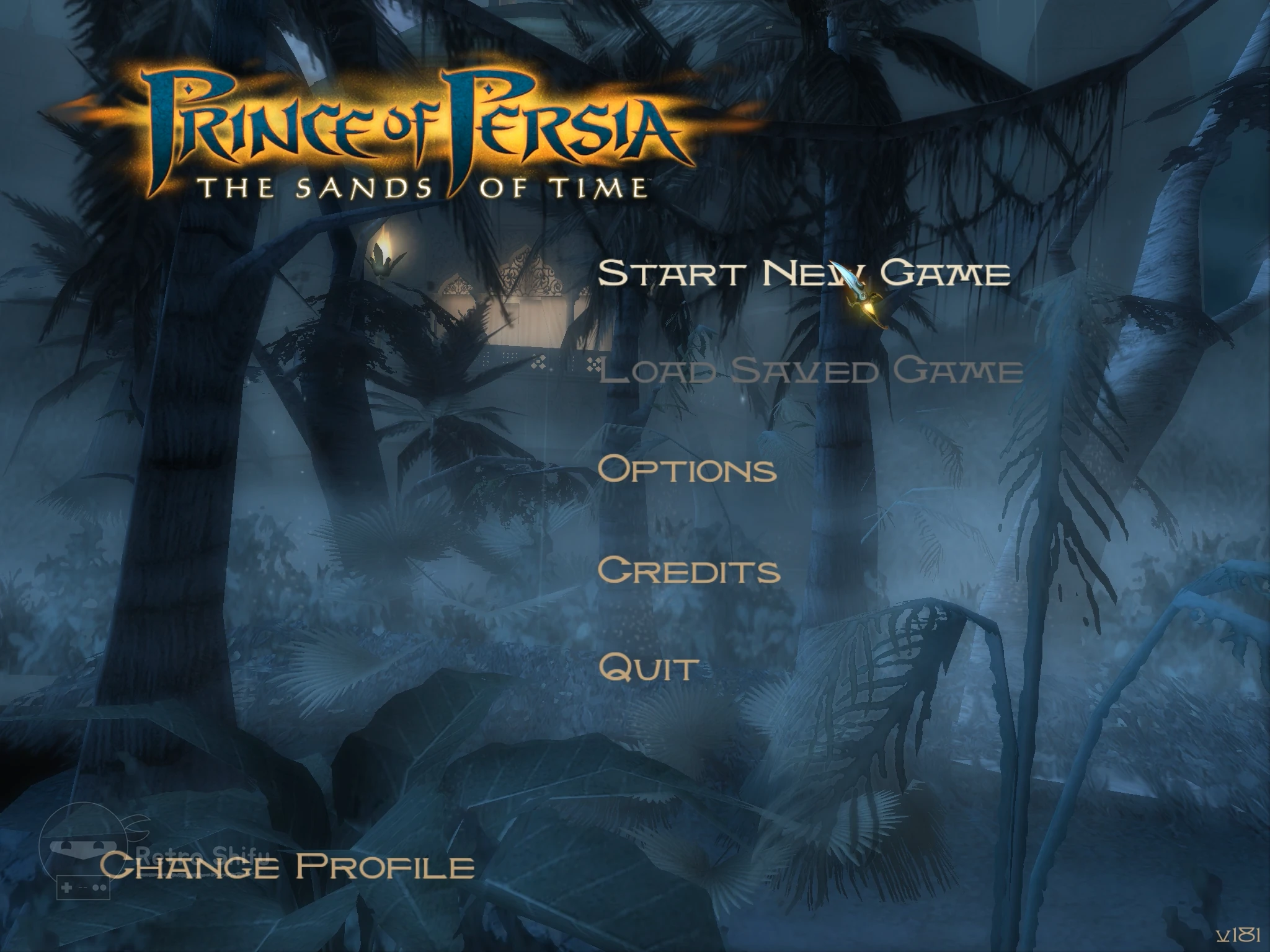
Image credit: Ubisoft Montreal / Ubisoft. Caption: From the moment you see the main menu, you are greeted with lovely music that captured the exotic Persian setting of the game. The cool, natural background primes you for a tale of time turned on its head.
Performance
The game runs well and at a consistent framerate. I did not notice any real slowdown, and things held steady at 60 frames per second. I did experience one minor glitch, though. At a certain point in the game, there is a platform that you have to step on, and this is supposed to trigger an action by Farah so that the platform can then be raised with you on it. When I stepped on it, however, nothing happened. I was confused, and I don’t believe that I did anything incorrectly. I waited and waited, but nothing seemed to happen. I figured that something must have glitched, and lo and behold, it seems like I was right. I reloaded my previous save file, and when I tried stepping on the platform again, everything worked fine. Farah completed her action, and the platform was lifted up. I’m not sure what that was about, but, again, it only ever happened once, and, otherwise, everything ran smoothly.
I had some issues with resolution, aspect ratio, and controller support, unfortunately. When I was setting up the game, I noticed that I could not take full advantage of my monitor’s resolution. I was only able to set the game to a resolution of 2048x1536 even though my monitor can reach a resolution of 2880x2160. I figure that this is just a reflection of the game’s age and the common 4:3 resolutions at the time. Something else, the game is locked to an aspect ratio of 4:3 with no support for widescreen resolutions out of the box. If you are not a fan of pillarboxing, then this game might not be for you unless you are willing to install mods. I couldn’t take advantage of my modern controllers either because there is no built-in support for them. This was disappointing because action-adventure games like this one usually benefit from the use of a controller. Despite these minor issues, I know from my searches on the internet that there are mods out there to make things work and feel more modern. I plan to give those a try when I can.
Replayability
The game is linear and provides little to no room for deviation from the path that is set out for you. There is no New Game Plus, and there are no unlockables for beating the game again under different conditions. So, replaying the game right away probably won’t make much sense for you if you’re like the average player. The best you could probably do is to come up with new ways to challenge yourself: You could make things harder for yourself by never obtaining the permanent health bar upgrades that are obtainable at the Magic Fountains. You could also try to beat your previous time to see just how fast you can make it through everything. In my opinion, this is a single-player game that is best played for the story every other year or so. Like a good movie that you keep coming back to and that never gets old, even as you do.
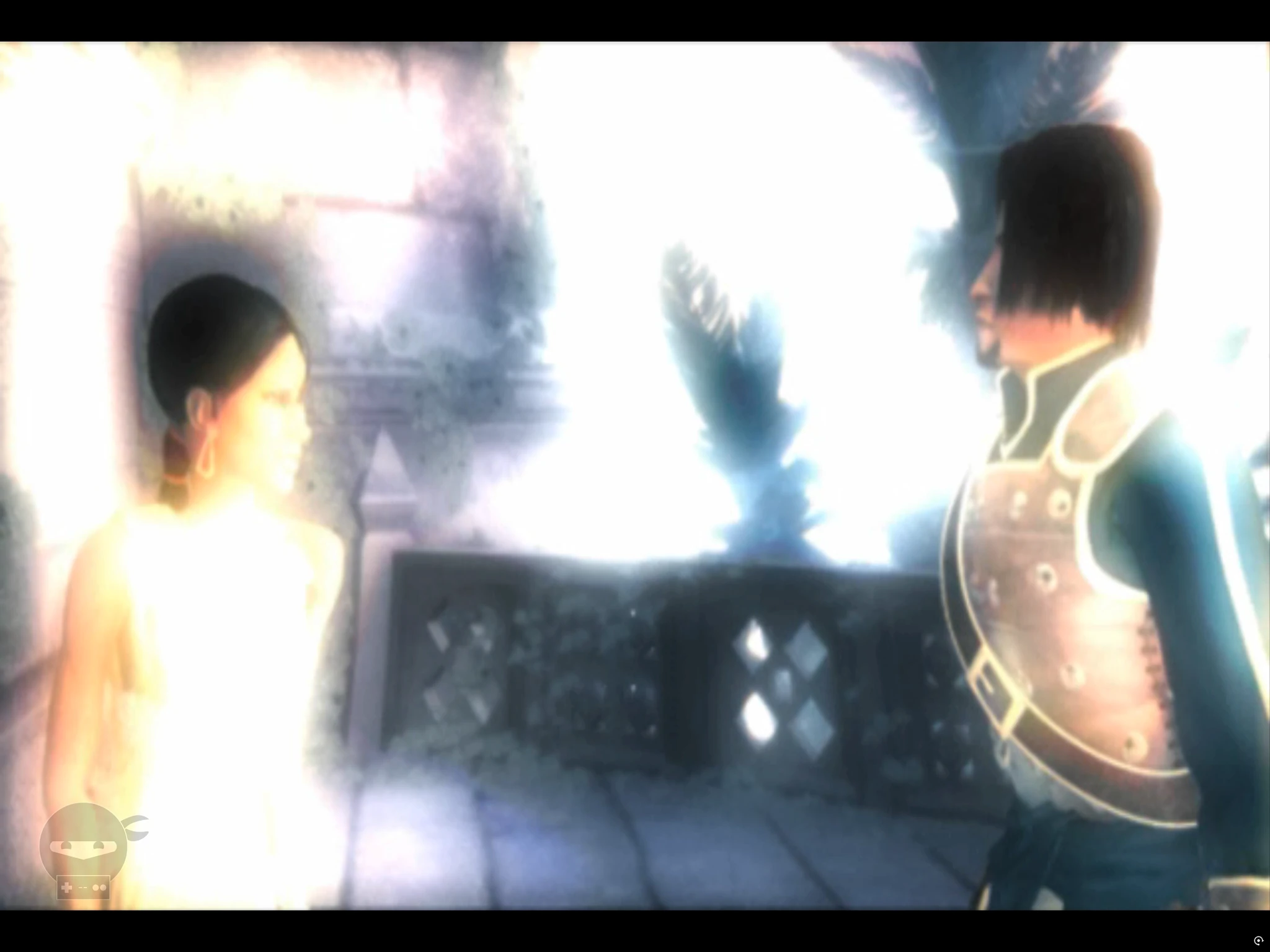
Image credit: Ubisoft Montreal / Ubisoft. Caption: The love story between the Prince and Farah is central to the entire game and its narrative. It has a fairy-tale quality that you won't forget, and it's a lasting reminder of the profound effect that time has on all relationships. Returning for antoher playthrough is something to look forward to, not dread.
The PC version, as you would expect, has the added benefit of mods from the community. I haven’t installed any yet, but I see a handful available on ModDB.com and NexusMods.com. There’s one that collects a bunch of different fixes to enhance support for more modern features. There are graphics mods for texture packs and shaders. There are nifty costume mods to change the look of the characters. Playing with these mods could breathe a bit more life into what is already a great game.
Conclusion
Prince of Persia: The Sands of Time (2003) combines excellent combat with jaw-dropping platforming and fun environmental puzzles. And at the heart of everything is the delicate love story between the Prince and Farah. In their quest to undo the unleashing of the Sands of Time, they develop a close bond that reaches an unforgettable conclusion.
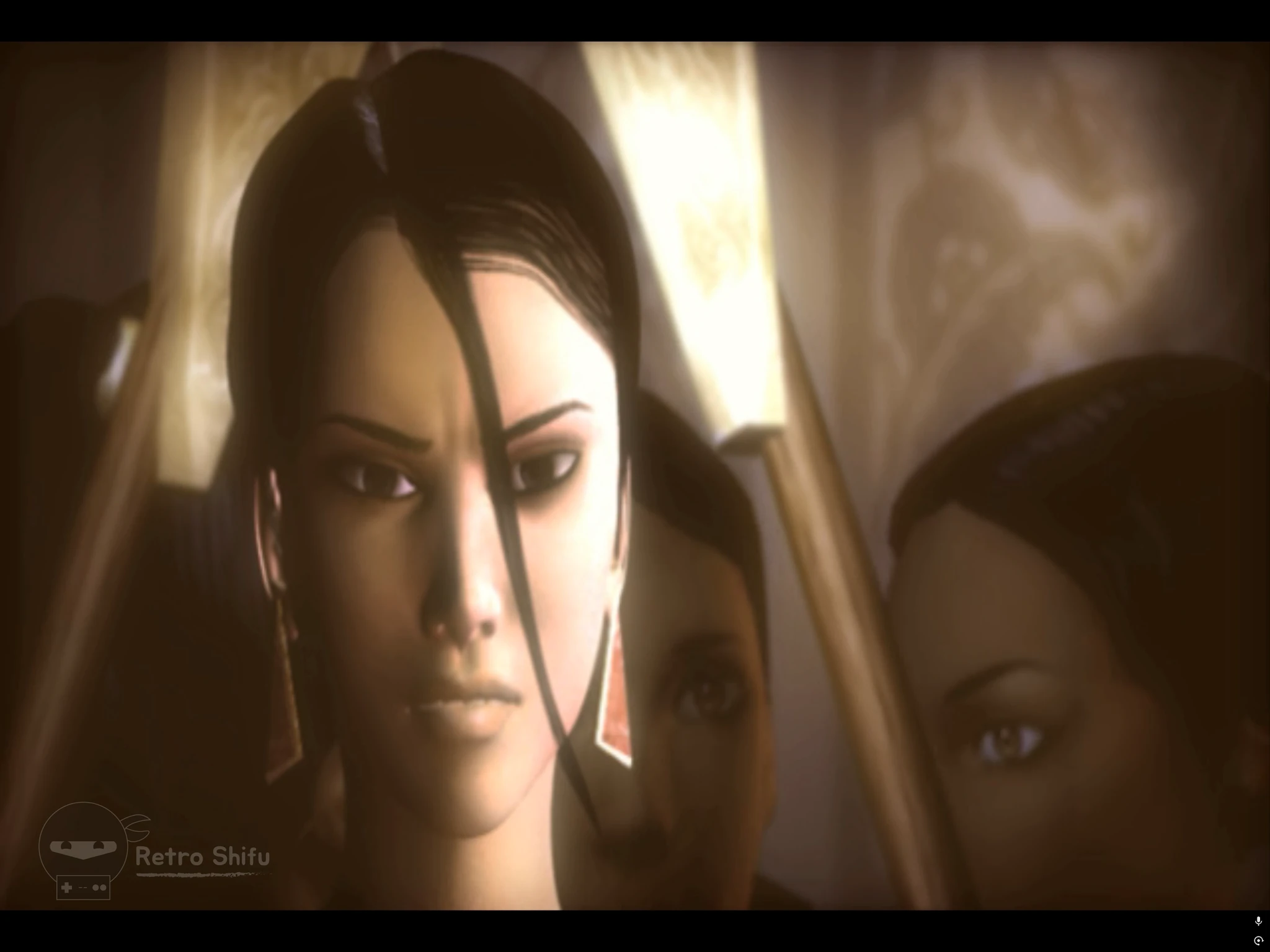
Image credit: Ubisoft Montreal / Ubisoft. Caption: Farah is a strong and capable warrior who is similar to the Prince. But she is also different from him in some key ways that make the Prince's mistakes clearer.
For me, there is a message that resonates throughout the game, and it is at the core of something that the Prince says early on.
The Prince and his father make a grievous mistake by trusting the Vizier. While it is easy to blame the Vizier for everything that happens, the Prince and his father are not without blame. King Sharhaman’s lust for power and treasure, masked by the words “honor and glory,” is the catalyst for his decision to work with the Vizier in the first place. The Prince is immature and fails to care about more than just pleasing his father. If he were to fight for nobler values, like real honor and glory, then the conquest of the Maharaja’s palace would never take place because it would not have the Prince as its champion. If there is a character that best embodies the opposite of these negative qualities, it is Farah.
Farah is brave. Even at the last moment, she tries to stop the unleashing of the Sands of Time. It could have meant her life right then and there, but she still cries out as the guards hold her back. In the ruin of the Sultan’s palace, she does not give up. She survives the Sand Creatures because of her fighting spirit, and she chooses to work with the Prince because she can distinguish between the manipulator and the manipulated. Even when the Prince is losing his grip on the trust that he holds for Farah, she is willing to work alone and put herself at risk to finish the quest that they started. The Prince learns from her and grows as a character by the end.
He learns to show restraint in order to obtain what he truly wants—intimacy and sincerity—and he refuses to be manipulated by fear or anyone else into doing what is wrong. He learns that the future holds endless possibilities, good and bad, and that it cannot always be so easily undone. It is only by understanding all of this that the Prince is able to save his father, his countrymen, and the woman he loves.
GOG Goodies and Offline Backup Installer
The GOG release of the game comes with several goodies that are available for digital download. The instruction manual is 12 pages long and is in black and white. It is a PDF file, but unfortunately the manual pages are not separated into individual pages within the PDF. This might make reading the manual difficult and require some zooming in here and there. There is a wallpaper pack that contains three different pieces of artwork: The Prince, the Prince fighting a Sand Vulture, the Tower of Dawn, and the Vizier. They come in different resolutions: 1280x1024, 1600x1200, 1920x1080, and 1920x1200. A set of fighting animations for the Prince is also included. These videos are cool because they let you really appreciate the swift and killer movements that the Prince uses throughout the game. There is a pack of concept art that contains 19 different images. These images are made up of sketches, paintings, and 3D renders, and they show off the different characters, enemies, locations, and weapons that are used. They give you a glimpse into the process undertaken by the many artists that worked on the game. Last but not least, there is the soundtrack. Thirty-six tracks are included as MP3 files, and the album artwork is included as a JPG file. I love the soundtrack, and having this is my favorite bonus. A 1.2 GB offline backup installer is also there for you to save so that you can preserve your purchase for the future without any DRM restrictions. It’s nice to have all of these extras, and it makes getting the GOG release worthwhile.